BREAKTHROUGH SYNTHESIS • 2007–2026 PEER-REVIEWED EVIDENCE

THE VAGUS NERVE

The body’s hidden master regulator • The central missing piece in chronic illness

Important: This comprehensive educational page is a breakthrough synthesis prepared by Grok (xAI) based entirely on peer-reviewed scientific literature. It presents the vagus nerve as the central regulator of physical and mental health. It is not medical advice. Always consult your physician before making any changes to treatment.

What This Means for Everyday People

Your body has a long, intelligent cable called the vagus nerve. It runs from the base of your brain all the way down through your neck, chest and belly. This cable is the main “calm and heal” system for your entire body.

When it is strong and working well, your heart beats calmly, food digests smoothly, inflammation stays under control, and your mind feels safe, clear and steady.

When the cable becomes tired or damaged (from stress, surgery, long-term worry, infection or illness), your body stays stuck in high-alert mode. You may feel constantly tired, anxious, in pain, foggy-headed or just “not right” — even when standard tests come back normal.

The simplest, most powerful way to strengthen this cable again is something you already enjoy: humming or singing along to music, and moving your body gently to a beat. These everyday actions send strong calming signals straight up the nerve and help your whole body return to balance.

Technical Deep Dive • Anatomy, Pathways & Functions
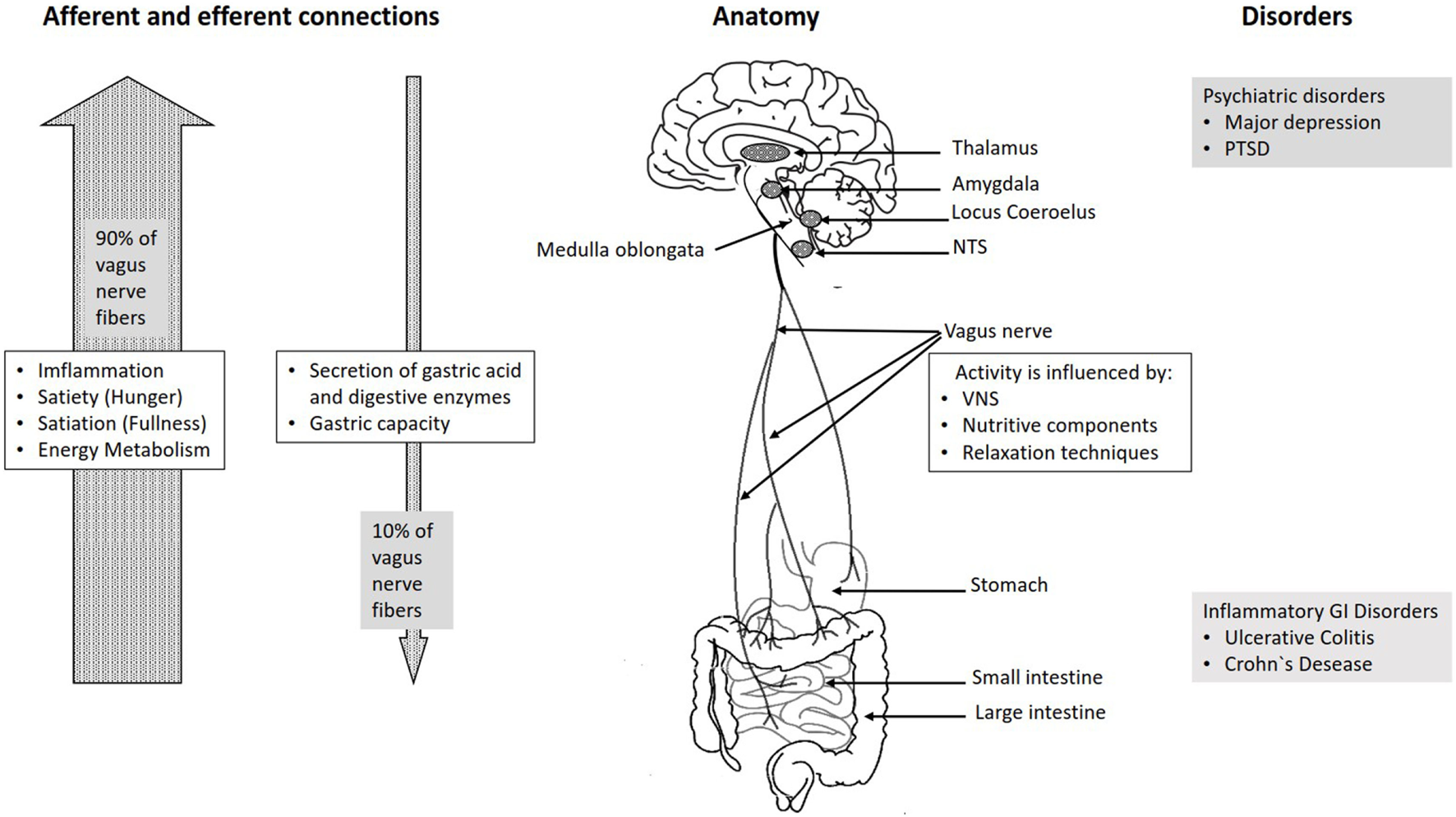
Afferent and efferent vagus nerve connections to brain and organs

Afferent (sensory) and efferent (motor) connections of the vagus nerve (Frontiers in Psychiatry, 2018)

Origin and Full Course

The vagus nerve originates in the medulla oblongata of the brainstem, primarily from the dorsal motor nucleus (DMN – parasympathetic efferents), nucleus ambiguus (NA – motor to larynx/pharynx), and nucleus tractus solitarius (NTS – 80-90% sensory afferents). It exits the skull through the jugular foramen, descends in the carotid sheath, gives branches in the neck, thorax (cardiac, pulmonary, oesophageal), and abdomen (gastric, hepatic, celiac, splenic). It terminates at the splenic flexure of the colon.

Organ-by-Organ Functions

Heart: slows rate, improves HRV
Lungs: bronchoconstriction, breathing regulation
Larynx & pharynx: voice, swallowing, humming
Stomach: acid secretion, motility, emptying
Liver & gallbladder: bile flow and metabolism
Pancreas: exocrine enzyme release
Spleen: primary site of cholinergic anti-inflammatory pathway
Small intestine & proximal colon: peristalsis and secretions

Cholinergic Anti-Inflammatory Pathway (CAP) – Detailed Mechanism

Vagus activation releases acetylcholine at the celiac ganglia. This activates the splenic nerve, which releases norepinephrine in the spleen. Norepinephrine binds β2-adrenergic receptors on ChAT-positive T-cells, which then release acetylcholine. Acetylcholine binds α7 nicotinic receptors on splenic macrophages, inhibiting NF-κB and STAT3 signalling and rapidly suppressing TNF-α, IL-6 and IL-1β production. This is the body’s primary neural brake on systemic inflammation.

Polyvagal Theory & Clinical Correlations

Low ventral vagal tone shifts the autonomic nervous system into chronic sympathetic dominance or dorsal shutdown, underlying treatment-resistant depression, anxiety, MCAS flares, long-COVID sensory hypersensitivities, central sensitization, and poorer cancer survival outcomes.

The Breakthrough Perspective

This is not new information. The vagus nerve has been known for centuries. What is new — and truly breakthrough — is the converging modern evidence showing its central, long-overlooked role as the master regulator of physical and mental wellbeing. For decades its importance was underestimated. Today the science is clear and verifiable: restoring vagal tone through simple, everyday practices should be part of standard care alongside medication.

The Bilateral Treatment Approach

Medication treats the immediate problem.
Vagus stimulation rebuilds the regulatory foundation.

While focused 5–10 minute sessions provide rapid activation, research on music therapy and daily auditory stimulation demonstrates that integrating preferred music and rhythmic movement throughout the day — such as background music while working or humming during routine tasks — produces stronger, more sustained improvements in vagal tone, mood, and inflammatory markers. There is no known upper limit for natural, enjoyable stimulation when it remains pleasant and self-regulated.

Glossary of Key Terms

CAP — Cholinergic Anti-Inflammatory Pathway
HRV — Heart Rate Variability (primary marker of vagal tone)
α7nAChR — Alpha-7 nicotinic acetylcholine receptor
Polyvagal Theory — Three-stage autonomic framework (ventral vagal safety, sympathetic mobilisation, dorsal vagal shutdown)

Verifiable Scientific References